Style Journal
Bespoke Tailoring Guides & Gentlecustom trousers manufacturer, wholesale custom trousers, custom pants manufacturer, private label trousers, bulk trousers supplier, custom slacks wholesale's Sartorial Advice
Mastering Custom Style
Meticulous Design & Modern Elegance
Sartorial Excellence
Timeless Wisdom from Columbus Master Clothiers
10 Best Custom Trousers and Slacks Suppliers
Table of Contents
- Custom Trousers and Slacks Suppliers: Made-to-Measure vs. Bespoke Production
- Compare Suiting Fabrics by Fiber Content and Typical 250–350 g/m² Weight
- Evaluate Sizing Systems Using ISO 8559-1 Anthropometric Measurements
- Check Fabric Strength with ISO 13934-1 Tensile and ISO 13937-2 Tear Tests
- Profile 10 Custom Trousers and Slacks Suppliers by Fit, Quality, and Service
- FAQS
- Conclusion
- Related Posts
Choosing among the 10 Best Custom Trousers and Slacks Suppliers takes more than comparing prices. A reliable partner should turn a design brief into trousers that fit consistently, feel comfortable, and arrive as promised. Check its fabric options, pattern-making experience, minimum order quantities, sample process, and production lead times. Ask how it handles measurements, grading, and fit corrections. A sample pair can reveal details a catalogue cannot: a waistband that sits flat, pockets that lie smoothly, and seams that hold their shape. Small details matter.
Fashion designer Yves Saint Laurent said, “Fashions fade, style is eternal.” His words offer a useful lens for choosing Custom Trousers and Slacks: prioritize durable construction and a fit suited to the wearer, not just a trend or attractive product photo. The suppliers in this guide are considered through practical criteria, including customization, communication, quality control, and service for different order sizes. Still, a polished website is not proof of dependable production. Request clear specifications and confirm how approvals, changes, and delivery updates work before committing. Even then, a first order may expose a gap in your brief. That is worth noticing. A good supplier should respond clearly, learn from feedback, and help refine the next run.
Custom Trousers and Slacks Suppliers: Made-to-Measure vs. Bespoke Production
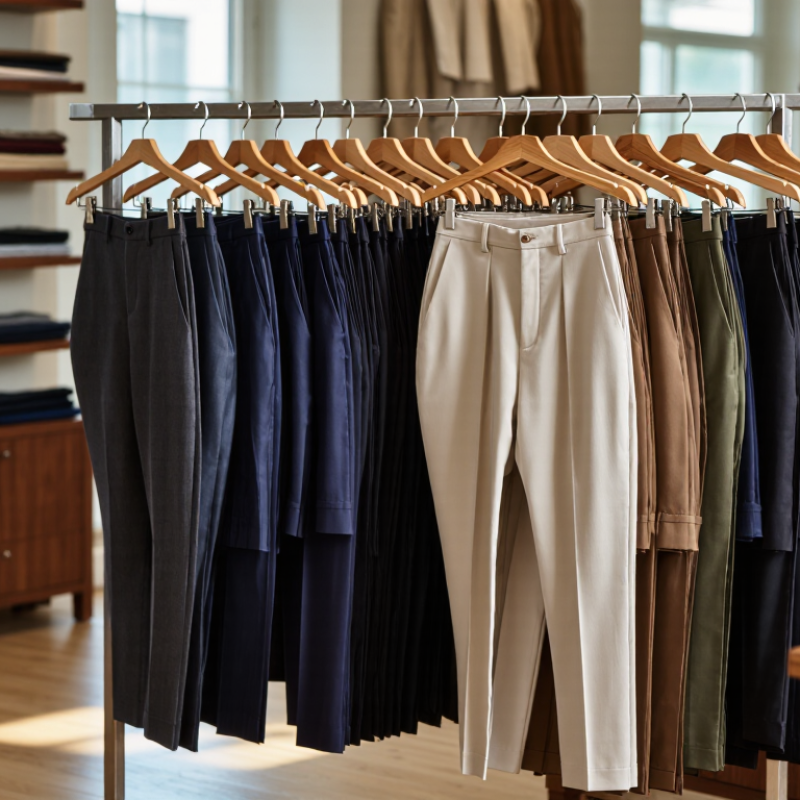
Custom trousers and slacks suppliers usually offer made-to-measure or bespoke production. The difference affects fit, cost, lead time, and how easily a style can be repeated. Made-to-measure starts with an existing block pattern, adjusted to a customer’s measurements. It suits brands seeking consistent sizing without developing every pattern from scratch. Ask suppliers how they record waist, rise, inseam, and thigh measurements, and whether they can provide a fit sample before bulk production. A tape measure alone is not enough. Posture and preferred ease matter, too.
Bespoke production builds a pattern around a specific design or wearer. It allows more control over details such as waistband shape, pleat depth, pocket placement, and leg taper. It may require more fittings, technical discussion, and time. Check whether the supplier can explain pattern revisions clearly and document approved measurements. Request fabric swatches and inspect stitching, seam allowances, closures, and pressing on a finished sample. Small details count. Neither method guarantees a good fit; unclear measurement instructions can undermine even careful work. Buyers should compare sample quality, communication, minimum order quantities, and repeat-order procedures. Some specifications may still need adjustment after the first fitting.
Compare Suiting Fabrics by Fiber Content and Typical 250–350 g/m² Weight
When comparing custom trouser suppliers, check fiber percentages and fabric weight together. A 280 g/m² cloth is not automatically durable or comfortable; weave, finishing, and yarn quality matter too. Textile Exchange’s Materials Market Report 2024 estimates global fiber production reached 124 million metric tonnes in 2023, with polyester making up 57%. That scale helps explain why wool-polyester blends are widely available, but availability alone is no quality test.
For tailored slacks, 250–350 g/m² is a useful comparison range, not a fixed standard. Lightweight wool around 250–280 g/m² can drape cleanly, while 300–350 g/m² often feels more substantial in cool weather. Wool-polyester blends may resist creasing, though excess synthetic fiber can feel less breathable. Cotton twill in a similar weight can feel sturdy, but may crease at the knee. Linen blends often feel cooler, yet can lose a crisp line. Small differences matter. Ask suppliers for exact fiber percentages, measured weight, and a swatch; hand-feel from a screen is guesswork. ASTM D3776 provides standard methods for measuring fabric mass per unit area, which makes supplier specifications easier to compare. Still, one point deserves scrutiny: a test result cannot predict how trousers will feel after a full day of sitting.
Suiting Fabric Weight by Fiber Content
Indicative weight ranges for common trouser and slacks fabrics. Actual specifications vary by weave, finish, and season.
Evaluate Sizing Systems Using ISO 8559-1 Anthropometric Measurements
When comparing custom trouser and slacks suppliers, ask how their size charts relate to ISO 8559-1 anthropometric measurements. The standard provides a consistent framework for defining body measurements; it does not guarantee a finished garment will fit every wearer. That distinction matters. A waist circumference measured on the body is not the same as a trouser waistband measured flat. Ask suppliers to label body dimensions, garment dimensions, and ease separately, then check where each tape point sits. For example, confirm waist, hip, and inside-leg references, plus the posture and tape tension used during measurement.
Reliable evaluation starts with a clear size table and a repeatable sample process. Request measurement instructions, tolerance ranges, and grading rules between sizes; compare them against several fit models rather than one ideal sample. Record whether rise, thigh, and seat proportions remain balanced when sizes change. Small inconsistencies show up quickly: a waistband may match the chart while the seat pulls when sitting. Fit is personal. ISO-based measurements improve communication, but fabric stretch, construction, and wearer preference still affect comfort. Measurements can be recorded consistently and still miss how a person moves. Use wear trials, revise the chart, and keep dated measurement records before approving repeat orders.
Check Fabric Strength with ISO 13934-1 Tensile and ISO 13937-2 Tear Tests
For custom trousers and slacks, fabric strength matters at the seat, knees, and pocket openings. Ask suppliers for test results tied to the actual fabric lot, not just a general material specification. ISO 13934-1 measures tensile properties using the strip method, including maximum force and elongation. ISO 13937-2 measures tear force with a trouser-shaped test specimen.
They reveal different weaknesses. A cloth may resist a steady pull yet tear more easily once a small cut begins.
Review the report details: fabric direction, conditioning, specimen count, units, and test date. Ask whether warp and weft results are reported separately; trouser panels may stress both directions. Compare results against your own minimum requirements and intended garment weight.
A lab number is useful, but it cannot predict every snag, seam failure, or wash-related change. Not a full guarantee. Request samples from the production lot and inspect high-stress areas after wear or laundering.
One overlooked detail: a strong fabric can still feel stiff or restrict movement. Strength should support the design, not replace fit and comfort checks.
Profile 10 Custom Trousers and Slacks Suppliers by Fit, Quality, and Service
Choosing custom trousers is less about finding one perfect supplier and more about matching a maker’s strengths to your needs. A useful comparison of ten suppliers should examine fit options, fabric quality, and service before considering price alone. Can the maker adjust the rise, thigh, and leg opening? Ask for measurement guidance, alteration policies, and a clear fitting process. Small details matter.
Quality is easier to judge when suppliers explain their materials and construction plainly. Look for fabric weight, fiber content, seam finishing, waistband structure, and care instructions. Request a swatch when available. A photograph cannot show how a fabric drapes or feels against the skin. Neither can a polished product description. Reviews may help, but check whether they discuss wear over time, not just delivery.
Service can shape the whole experience. Compare response times, sample or fitting support, production estimates, and how problems are handled. A supplier with many options may still be a poor match if communication feels vague. I would also leave room for uncertainty: sizing can vary between makers, and one successful pair does not guarantee the next will fit identically. Ask specific questions, keep measurement records, and treat promises as claims to verify. The comparison should help readers find a dependable fit, not declare a universal winner.
10 Best Custom Trousers and Slacks Suppliers — Profile 10 Custom Trousers and Slacks Suppliers by Fit, Quality, and Service
The entries below are supplier types, not named or independently verified businesses. They summarize common sourcing models; actual fit options, materials, minimums, lead times, and services vary by supplier and should be confirmed before ordering.
| # | Supplier Profile | Fit and Customization | Quality Considerations | Typical Service Strength | Best Suited For | Questions to Confirm |
|---|---|---|---|---|---|---|
| 1 | Made-to-Measure Trouser Specialist | Usually offers measurements, fit adjustments, and choices such as rise, leg shape, waistband, and hem finish. | Review fabric swatches, seam finishing, construction details, and the supplier’s alteration or remake policy. | Measurement guidance and fit-focused consultation. | Customers seeking individually adjusted trousers rather than a standard size. | How are measurements taken, and what happens if the first fitting needs adjustment? |
| 2 | Small-Batch Cut-and-Sew Workshop | Can often adapt an existing pattern or develop a small run with selected design details. | Ask for a pre-production sample and confirm fabric, trim, stitching, and measurement tolerances. | Direct communication and closer oversight of development samples. | Emerging labels and limited-run collections. | What are the minimum order, sampling charges, production schedule, and inspection process? |
| 3 | Private-Label Apparel Manufacturer | May support custom patterns, grading, labels, and specification-based sizing. | Quality depends on the approved specification, material sourcing, sample approval, and production controls. | Product development and coordinated manufacturing services. | Retailers or labels building a distinct trouser range. | Which pattern, grading, labeling, and packaging services are included in the quote? |
| 4 | Workwear Trouser Producer | Common options include functional pocket layouts, reinforced areas, and fit blocks designed for movement. | Check fabric durability, seam reinforcement, care instructions, and any applicable safety requirements. | Practical product guidance for uniforms and repeated use. | Organizations ordering staff or occupational trousers. | Can the fabric and construction meet the intended work conditions and laundering routine? |
| 5 | Uniform and Group-Order Supplier | Often provides a defined size range, with selected alterations or consistent group sizing. | Assess size consistency across samples, fabric availability, and repeat-order matching. | Order coordination and support for outfitting groups. | Schools, hospitality teams, offices, and other uniform programs. | How are size exchanges, replenishment orders, and discontinued fabrics handled? |
| 6 | Premium Tailoring Workshop | May offer detailed pattern adjustments and a choice of tailoring features and finishes. | Inspect cloth composition, lining, waistband construction, buttoning, and finishing quality. | One-to-one design and fitting consultations. | Buyers prioritizing tailored appearance and finish. | Are fittings in person or remote, and are alterations included in the service? |
| 7 | Digital Made-to-Measure Provider | Typically uses an online measurement process and a menu of fit and style selections. | Request fabric details and clarify how measurement errors, fit issues, and remakes are addressed. | Remote ordering and online order-management tools. | Customers who prefer online ordering and do not require in-person fittings. | What measurement support, fit guarantee, and return or alteration terms are available? |
| 8 | Sustainable-Material Trouser Maker | Custom options depend on the available fabric and production model; fit may range from standard blocks to made-to-measure. | Verify fiber content, material documentation, dyeing details, and the scope of any environmental claims. | Material information and guidance on fabric selection. | Buyers with specific material or sourcing preferences. | Can the supplier provide documentation supporting material and sourcing claims? |
| 9 | Performance-Fabric Trouser Supplier | May offer fit options designed around stretch, mobility, or particular use cases. | Check fabric composition, recovery, care requirements, and performance claims against the intended use. | Product advice focused on fabric function and wear conditions. | Travel, active work, and everyday use where movement or easy care matters. | How does the fabric perform after laundering, and are test details available? |
| 10 | Full-Service Product Development Partner | May assist with concept development, pattern making, fit samples, grading, and production specifications. | Use approved samples and written specifications to align material, construction, and sizing expectations. | Support across multiple stages of product development. | Businesses creating a new custom trouser product from an initial concept. | Which development stages are included, who owns the patterns, and how are revisions billed? |
FAQS
Made-to-measure adjusts an existing pattern to your measurements. Bespoke starts with a pattern created for a specific wearer or design. More control takes time.
Ask how they record waist, rise, inseam, and thigh measurements. Posture and preferred ease matter, too. A tape measure isn’t enough.
Ask whether a fit sample is available. Try it while sitting and standing, then note tightness or excess fabric. Small adjustments matter.
You can discuss waistband shape, pleat depth, pocket placement, and leg taper. Keep approved measurements and revisions in writing. Details can get missed.
Request a finished sample and inspect the stitching, seam allowances, closures, and pressing. Fabric swatches help reveal weight and drape. Photos fall short.
Compare sample quality, communication, minimum order quantities, and repeat-order procedures. Ask about alteration policies and fitting support. I might still overlook something.
Not fully. Check the fiber content, fabric weight, and care instructions, then handle a swatch if available. Touch matters.
No. Sizing can vary, and specifications may need adjustment after the first fitting. Keep measurement records and verify promises. Be ready to revise.
Conclusion
This guide to Custom Trousers and Slacks explains how to choose a supplier based on fit, fabric, construction, and service. It compares made-to-measure production, which adapts standard patterns to an individual’s measurements, with bespoke production, which typically involves a more personalized pattern-making and fitting process. It also outlines how fiber content and the typical 250–350 g/m² fabric-weight range can help buyers assess comfort, drape, and suitability for different settings.
The article describes practical checks for supplier quality, including reviewing sizing methods informed by ISO 8559-1 anthropometric measurements and fabric strength results from ISO 13934-1 tensile and ISO 13937-2 tear tests. Finally, it profiles ten suppliers by their fit options, material quality, production approach, and customer service, helping readers compare choices and identify a partner suited to their requirements.

Blog Tags: